
Food and pharmaceutical purification
- TOP
- Applications of Ion Exchange Resins
- Food and pharmaceutical purification
Sugar refining
Ion exchange resins are used in various industrial applications. We have introduced their use in the production of pure and ultrapure water, recovery of precious metals, and removal of harmful metals from wastewater, but they are also active in the production of food, chemicals, and pharmaceuticals.
Among these, one of the main uses of many ion exchange resins is in the production of "sugar."
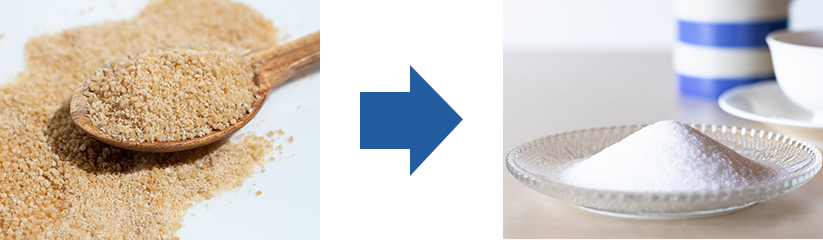
Sugar is made from "sugarcane," which is produced in warm regions such as Okinawa and South America, and "sugar beet," produced in cooler regions such as Hokkaido and Europe. The overview of the sugar production process is as follows.
【Sugar Production Process】


Sugarcane and sugar beets are chopped and soaked in water to extract the liquid sugar, which is then filtered and purified to produce a colorless, clear liquid sugar. This liquid sugar is heated and concentrated to form clean sugar crystals, and drying them results in pure white sugar products. In the process of removing impurities, materials such as activated carbon are used, but "ion exchange resin" also plays a significant role in eliminating impurities.
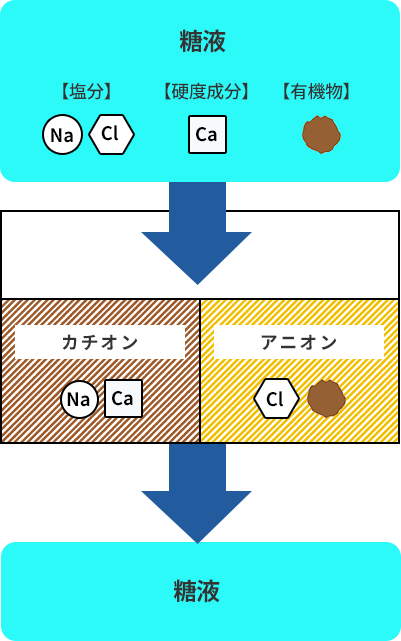
The roles played by ion exchange resins in sugar refining are 'decolorization,' 'demineralization,' and 'softening.'
The sugar solution, which is the raw material for sugar, contains various impurities besides sugar. The removal of impurities such as calcium and organic acids, through processes like demineralization and softening, is the primary role of ion exchange resins. However, since the solution in question is a high-concentration sugar solution, the optimal resins are selected from various types of cation and anion exchange resins. Activated carbon is mainly used for decolorization, but organic substances that cannot be completely removed by this method are removed using anion exchange resins. Hardness components are removed with cation resins, while demineralization is performed using both cation and anion resins.
Sugar is said to not only provide sweetness and a sense of happiness, but also to help relieve fatigue and support brain function, and ion exchange resin is a product that plays a role in this process.
Liquid purification
Another application of ion exchange resins in the food industry is the purification of liquids such as citrus juices and alcoholic beverages.
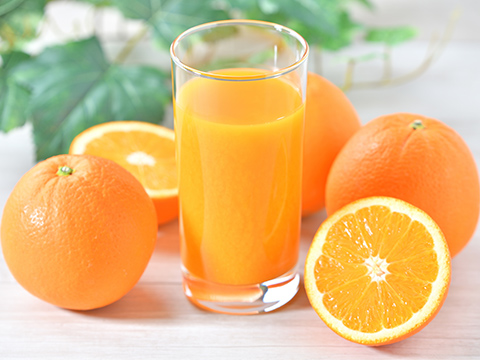
Citrus fruits can have a strong 'sour' or 'bitter' taste. Citrus juice contains a lot of bitter components such as naringin and limonin, as well as sour components like citric acid and L-ascorbic acid (vitamin C), and these determine the flavor of citrus juice.
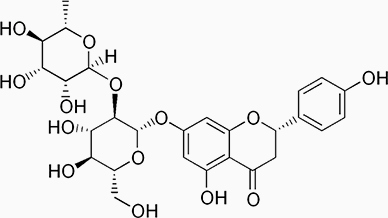
Bitterness: Structure of Naringin
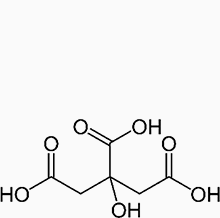
Sourness: Structure of Citric Acid
As can be seen from their structures, these bitter and acidic components are substances that can be adsorbed by an anion resin. By passing the juice through an anion resin to remove these bitter and acidic components, a sweet citrus juice product is created.
Purification of alcoholic beverages
Ion exchange resins are also used in the purification of alcoholic beverages. Wines and shochu contain organic acids as impurities, as well as hardness components. Additionally, shochu contains aldehydes that can cause unpleasant intoxication. Ion exchange resins are used to remove these substances to produce tasty alcoholic drinks.

Furthermore, in the field of pharmaceuticals, ion exchange resins are also used to remove impurities and hardness components contained in drugs. This is due to the resin's inherent adsorption and separation functions. In addition, various by-products are produced during the manufacture of pharmaceuticals. The role of extracting only the necessary drugs from these by-products is also performed by ion exchange resins. Moreover, there are cases where ingesting ion exchange resins themselves can help treat diseases. Potassium is a substance necessary for the human body, helping to lower blood pressure and support muscle function, but excessive intake can lead to health problems. To adsorb this potassium, special ion exchange resins approved by law and other regulations may sometimes be ingested.
Ion exchange resins are industrial products that play an important role in producing pure water and recovering metals, but they also play an important role in manufacturing everyday foods and pharmaceuticals. They are also useful for enjoying sweet juice at home parties or feeling pleasantly intoxicated with delicious alcohol.