
Ion exchange resin for catalysts
- TOP
- Applications of Ion Exchange Resins
- Ion exchange resin for catalysts
About Ion Exchange Resins for Catalysts
Ion exchange resins, particularly strongly acidic cation exchange resins, are used as 'catalysts' in the production of various industrial products. Our company offers a range of ion exchange resins for catalytic purposes and can propose the most suitable ion exchange resin according to your application.
Advantages as a catalyst
Currently, various chemical products derived from petroleum are being manufactured, and acids or alkalis are used as catalysts for these processes. Ion exchange resins are insoluble solids that possess acidic or basic groups, so they can be used as solid catalysts instead of liquid catalysts such as sulfuric acid.
The benefits of using ion exchange resins are as follows:
Easy Separation

Since ion exchange resins are solid, they can be easily separated and recovered after the reaction.
Continuous Reactions Possible
By filling the reaction tower with ion exchange resin and passing the raw materials through it, continuous reactions can be achieved, allowing for the rationali-zation of the reaction process.
Cost Reduction Possible
Neutralization treatment required when using liquids such as sulfuric acid is no longer necessary, and the recovered ion exchange resin can be reused, operational costs can be reduced. In addition, because there is no need to use highly acidic liquids, it is possible to reduce the cost of equipment materials.
Examples of use as a catalyst
Examples of cases where ion exchange resins are used as catalysts are as follows.
-
Manufacture of bisphenol A (BPA)
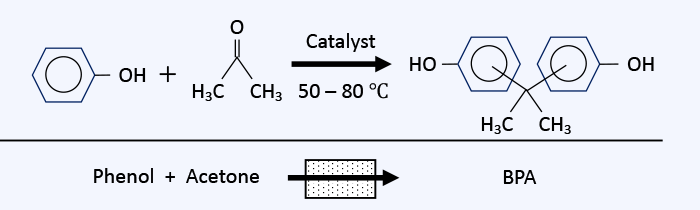
Bisphenol A, which serves as a raw material for epoxy resin, is synthesized through a condensation reaction between phenol and acetone, using a strongly acidic cation exchange resin as a catalyst.
-
Production of Methyl tert-butyl ether(MTBE) or Ethyl tert-butyl ether(ETBE)
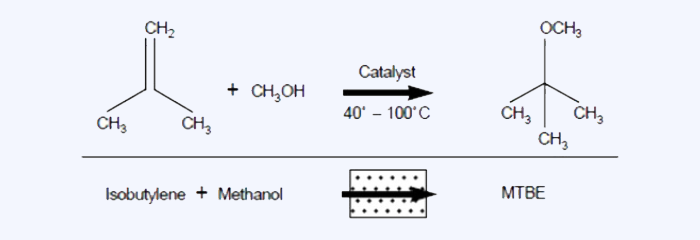
Strongly acidic cation exchange resins are used as catalysts for the production of MTBE and ETBE, which are used as additives.
-
Others
Strongly acidic cation exchange resins are used as solid acid catalysts for the hydration, esterification, alkylation, and hydrogenation reactions of olefins.
Performance Requirements for Ion Exchange Resins for Catalysts
Since it is used as a catalyst in chemical reactions, the following characteristics are required.
High Chemical Stability
High chemical stability is required, such as resistance to high temperatures, chemicals, and organic substances. Therefore, highly cross-linked cation exchange resins or cation exchange resins with specially designed manu-facturing methods can be proposed.
High Reactivity
Highly reactive ion exchange resins are used to carry out chemical reactions stably. In this context, porous-type ion exchange resins can be suggested.
Low Elution
To ensure the purity of chemical products, it is necessary to reduce elution from ion exchange resins. Measures such as enhanc-ing the stability of the ion exchange resin, pre-washing before delivery, and drying treatment are possible.
Ion exchange resin for catalysts that we propose
The ion exchange resins we can offer are as follows.
- High crosslinked porous-type strongly acidic cation exchange resin
- Low crosslinked gel-type strongly acidic cation exchange resin
- Heat-resistant strongly acidic cation exchange resin
- Low elution strongly acidic cation exchange resin
- Strongly basic anion exchange resin for catalysts
- Preprocessed products such as particle size adjustment, drying treatment, and pre-washing